
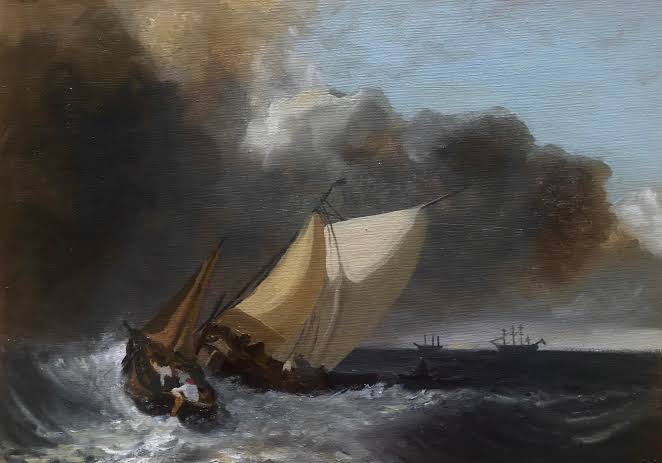
Some of Christendom’s most powerful hymns were written in the midst of life’s greatest sorrows. Brokenness and despair has a way of sharpening the senses but softening our heart before God. Perhaps the most well-known example of this is the story behind the hymn “It Is Well with My Soul” penned by Horatio Spafford in what was admittedly his darkest hour.
The year was 1873 and Horatio’s wife, Anne, and four daughters (Annie, Maggie, Bessie, and Tanetta) were traveling to Europe when their ship collided with another vessel. In just twelve minutes the ship had completely sank. While Anne survived, the four daughters did not. Upon returning to safety, Anne sent a telegram to Horatio with these simple words: “Saved alone. What shall I do?” Horatio boarded a ship to retrieve her and while sailing across the very spot that his four daughters had died, he wrote the words, “When peace, like a river, attendeth my way, When sorrows like sea billows roll…”
I have a hard time comprehending this kind of peace in the midst of such crushing sorrow. Many of us will never experience this kind of utter brokenness. But when we do, inevitably, encounter the valleys in life, whether these be negative consequences of our own disobedience to God or from His sovereign and sanctifying will in our life, we have two options in how we respond: with faith or with rebellion.
The Psalmist in Chapter Seventy-Seven, undeniably stricken with grief, doubt, and confusion chooses, in the day of his trouble, to seek the Lord. The Psalmist writes “I will remember the deeds of the LORD; yes, I will remember your wonders of old” (Ps. 77:11). On this verse, Charles Spurgeon comments, “If no good was in the present, memory ransacked the past to find consolation. She fain would borrow a light from the alters of yesterday to light the gloomy today. It is our duty to search for comfort, and not in sullen indolence yield to despair.” I can only assume Horatio Spafford, in his darkest hour, found consolation, not in the present, but in his ransacked memory of God’s past faithfulness.
In Chapter Seventy-Seven, the Psalmist is seemingly coaching himself to remember the Lord’s faithfulness in the midst of despair and apparent darkness all around him. I appreciate how often the Psalms go from anguish to remembering. Just in this Seventy-Seventh Chapter we see the author remember, ponder, and meditate on the mighty deeds of God.
How do you respond to hardship, despair, brokenness, and confusion in life? The Psalmist chooses to remember God’s faithfulness. The realness of the writer’s expressed thoughts should not be missed but noted. He cries (v.1), He questions God’s love (v.7), and even claims his soul refuses to be comforted. But look how the writer leads himself to his reality. “Then I said, ‘I will appeal to this…” His anguish turns to remembering. He appeals to God’s faithfulness. I will remember…I will ponder…I will meditate…on Your wonders, work, and mighty deeds.
I’m reminded in this moment that Jesus Christ, God incarnate, knows our sorrows very well. In John 11:35, the shortest verse in the Bible, Jesus wept for his deceased (but soon to be raised) friend Lazarus. Isaiah describes our Savior as “…despised and rejected by men, a man of sorrows and acquainted with grief” (Isa. 53:3). The author of Hebrews (4:15) writes “…we do not have a high priest who is unable to sympathize with our weaknesses…” David Mathis notes of Christ, “He bore our griefs. He carried our sorrows. In his mission to save us, he entered not only into our flesh and blood but into our sorrows.” Spurgeon wrote much on the Psalms. Of this Psalm specifically he wrote “Alas, my God, the writer of this exposition well knows what thy servant Asaph meant, for his soul is familiar with the way of grief. Deep glens and lonely caves of soul depressions, my spirit knows full well your awful glooms!” Here, Spurgeon is relating deeply with Asaph and his honest state of brokenness.
As Horatio pours his heart out before God in prayer and in his famous hymn, he does so before a Father who knows every sorrow and is familiar with our grief. Even when pain was unspeakable, Horatio held fast to a single, steady truth: God is faithful.
Exactly 50 years after Horatio wrote It Is Well with My Soul, another hymn-writer would pen a song that captures the truth that God is faithful.
Thomas Chisholm was a humble man who lived an unremarkable life. Born in 1866 in a log cabin in Kentucky, he grew up and worked as a school teacher, a newspaper editor, and insurance agent, then he retired and spent his remaining days at the Methodist Home for the Aged in New Jersey.
He once wrote, “My income has not been large at any time due to impaired health in the earlier years which has followed me on until now. Although I must not fail to record here the unfailing faithfulness of a covenant-keeping God and that He has given me many wonderful displays of His providing care, for which I am filled with astonishing gratefulness.”
Though his life was marked with consistent health issues and pain, we know him today as the author of Great is Thy Faithfulness (1923).
This hymn is based upon Lamentations 3:22-231:
22 The steadfast love of the Lord never ceases; his mercies never come to an end; 23 they are new every morning; great is your faithfulness.
I’ve spent much of the latter half of 2025 and the first 3-4 months of 2026 in the Psalms. A reoccurring theme through the Psalms of Asaph is summed up in this way: God is faithful and we are often faithless. But, let us not forget Who the object of our faith is: Jesus Christ. Appeal to His past faithfulness and do not despair. I leave you with how we remember God’s faithfulness in times of trouble: prayer. Matthew Henry stated well “Days of trouble must be days of prayer.” He goes on to describe how we are to respond to life’s despair not in the flesh but in the Spirit. He writes “…in days of inward trouble, especially when God seems to have withdrawn from us, we must seek him, and seek till we find him. In the day of his trouble he did not seek for the diversions of business or recreation, to shake off his trouble that way, but he sought God, and his favour and grace. Those that are under trouble of mind, must not think to drink it away, or laugh it away, but pray it away.“
Times of trouble must be times of prayer, and as you pray remember God’s faithfulness and praise Him for it. Do not despair.
Footnotes:
1The Holy Bible: English Standard Version (Wheaton, IL: Crossway Bibles, 2025), La 3:22–23.
We see the Psalms of David and Asaph (Psalms 50, 73–83)


Leave a Reply