
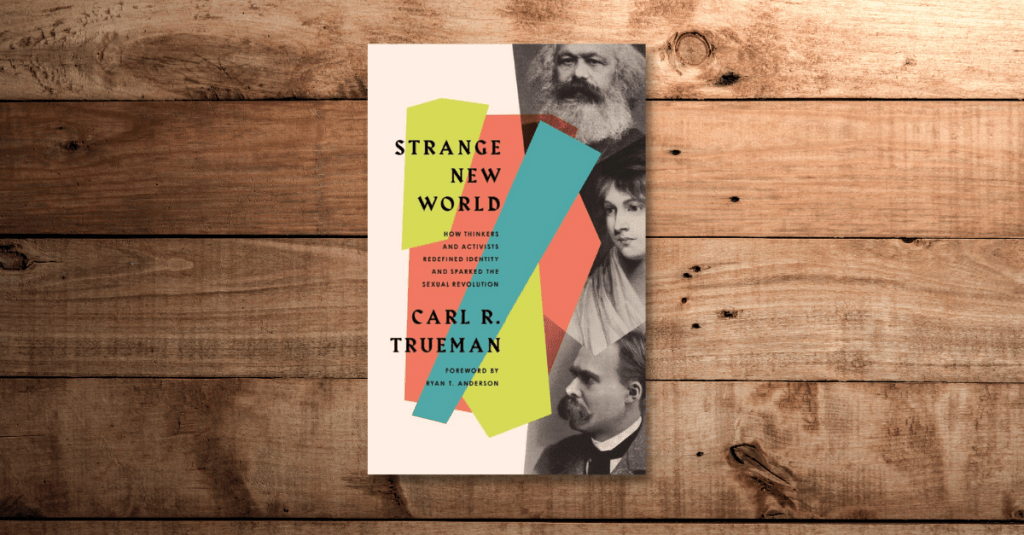
I can hear our great grandparents laughing. Do you hear them? I think they began to laugh in disbelief shortly after a man competed in and won a women’s swimming competition. Wait. No, maybe they started laughing once they heard the statement, “I am a woman trapped in a man’s body.” Life is a little disorienting right now. Can you imagine why? Up is down and down is up. Relativism is rampant. And among the many voices telling us what is the newest “truth” comes an excellent explanation of our current plight – Strange New World: How Thinkers and Activists Redefined Identity and Sparked the Sexual Revolution. The prequel to this book can actually be found in Trueman’s 2020 work, The Rise and Triumph of the Modern Self. Shane Morris describes Trueman’s 2020 book as “a major achievement for illuminating the centuries-long process by which a statement like ‘I am a woman trapped in a man’s body’ came to be regarded not only as meaningful, but as indisputable.” While the book is detailed, it comes with a significant commitment – about 432 pages worth of commitment. Trueman wanted to offer a condensed and more accessible version of his book. Enter Strange New World.
There are only a few books in my personal library that I would consider seminal works in their respective category. Strange New World: How Thinkers and Activists Redefined Identity and Sparked the Sexual Revolution by Carl Trueman is a brilliant capturing of our society in 2023 and beyond. Truman provides a deeply intellectual approach and thorough understanding of why we experience what we experience as a society. He looks to past philosophers to explain our present dilemma.
Carl R. Trueman is a Christian theologian and ecclesiastical historian. He was Professor of Historical Theology and Church History at Westminster Theological Seminary, where he held the Paul Woolley Chair of Church History. He is widely regarded as one of America’s most respected Christian thinkers.
The book is divided into three manageable sections: how the human person became a self, how the self became sexualized, and how sex became politicized. Each of these points are acutely relevant to how the world thinks today. I appreciate Trueman’s approach in the book to this sexual revolution we find ourselves in. He doesn’t always present his position loudly, but rather presents the facts clearly, and offers some critical thinking on each point. You can tell he wants the reader to come to their own understanding of what he is sharing. While Truman’s dissertation on post-modern thought (especially in relation to the Western world) is expansive, it is clearly communicated from a strong biblical perspective.
How the Human Person Became a Self
Self is an elusive term becoming ever more challenging to define as we increase further down the path towards subjective biology and agency. Ryan T. Anderson, President of the Ethics and Public Policy Center, and author of the forward of this book provides some distinction on the word. He writes “…the person of the Psalms, of St. Paul’s epistles, and of St. Augustine’s Confessions was also a ‘self’ in the sense of having an interior life. But the inward turn of the biblical tradition was at the service of the outward turn toward God. The ‘self’ that Western civilization cultivated, up until just a few hundred years ago, was what Harvard political theorist Michael Sandel described as an ‘encumbered’ self, in contrast to modernity’s ‘unencumbered’ self” (12). We see a stark contract between who God created man to be and modernity’s “unencumbered” self. The person God created man to be is one who seeks to live in accordance with biblical truth with eternal life as the culmination of faithfully following God and being set free by faith in Him through His grace. Modern man has gravely distorted human expression, individualism, and the source of truth. Truman notes, “there is a commonsensical way in which we use the idea of self to refer to our basic consciousness of ourselves as individual people. For example, I know that I am Jacob Robertson, an American living in the state of Georgia, not Bob Iger, CEO of Disney, or Jeff Bezos, founder of Amazon. These two are different individuals because they posses different self-conscious beings with different bodies and minds. Truman goes on to explain how he uses the term in his book – “When I use the term self in this book, I am referring not to this commonsense way of using the term but rather to the deeper notion of where the ‘real me’ is to be found, how that shapes my view of life, and in what the fulfillment of happiness of that ‘real me’ consists” (22). Truman spills quite a bit of ink detailing how philosophers of old have developed and placed words around this concept of self. Rousseau taught that men and women are essentially born good but social conditioning has corrupted all (111). Friedrich Nietzsche attempted to convince his contemporaries of the consequences of “God’s death.” He is famous for stating that “God is dead.” Karl Marx believed in a human nature; however, he taught that human nature is always in a state of fluctuation based on one’s cultural context. According to Marx, history is a story of the powerful oppressing the powerless, (the bourgeoisie and the proletariat) and because traditional morals were instruments in the hands of the oppressor, human nature does not include a responsibility to obey any “so-called” objective morality (191). And lastly, Charles Darwin, who was actually great friends with Nietzsche and Marx, contended that if human life has no creator then authoritative reasoning is unnecessary. Truman summarizes these philosopher’s endowment to society in this way: “Darwin strips the world of intrinsic meaning through natural selection; Nietzsche, through his polemic against metaphysics; Marx, through . . . a radical and consistent materialism . . .” (191-92). Conforming thoughts, feelings, and actions to objective reality has become the exception, not the rule. Man’s inner self has become the source of truth. And this is why we have a pervasive culture of expressive individualism firmly planted in the authenticity of one’s own feelings. As the construct of self has become under assault, so have once simply self-evident truths.
How Self Became Sexualized
Trueman cannot explain the greater essence of how man views the human psyche without mentioning Sigmund Freud. Freud believed that sex was one’s identity. Freud also believed that sexual gratification is the highest good for man; and as such, sexual repression is not morally right, but morally evil. Freud would contend that man cannot live as their authentic self if they observe any kind of sexual ethic. It’s here that I circle back to the question of authority. Man is no longer viewed as accountable to the highest authority – God. No, modern self is now accountable to the therapist as they provide counsel on how to be true to oneself – giving rise to what Philip Rieff describes as the “triumph of the therapeutic.” And it is in this context that Trueman contends self becomes sexualized. For centuries of human history our sexual identity was uninteresting and factual, but now is a pursuit of people becoming true to their inner sexual desires. There is no such thing as self-evidence. Anderson supports Trueman’s contention when he writes “Historically, one’s ‘gender identity’ was determined by one’s bodily sex, as was one’s ‘sexual orientation’ – a male’s ‘identity’ was a man, and he was ‘oriented’ by nature and reason to unite with a women, regardless of how his (fallen) desires might incline him” (13). As the concept of traditional marriage and sexuality becomes threatened, the conversation moves to the public square.
How Sex Became Politicized
If it’s been determined that man’s sexuality is his deepest inner truth, and politics is, in essence, the promotion of truth, then it’s inevitable and a likely result that sex would be politicized. Culture once was the ground in which virtues were cultivated. Virtues like family and religion were able to flourish and grow in this context. Now, the laws of the land are used to suppress these cultural institutions because they are in opposition to sexual “authenticity”. The conservative church down the street, the homeschool group, the Christian businessman, the principled politician — all of these people are bigoted, per the ideology that is being distributed to society. The politician’s motivation to create “safe spaces” free from criticism is to develop a new kind of politics, one where federal mandates will punish you if you object to any ideology that does not line up with their’s. If you sit for any length of time pondering how we got here you may begin to hyperventilate. Don’t lose sight of God’s sovereignty so quickly.
Where Do We Go From Here?
Some days it more challenging than others to recalibrate, find our bearings and move forward as God calls us to. Trueman provides some encouragement and clear direction when he calls the church to “preach sound doctrine boldly, to live in an intentional countercultural way according to biblical and liturgical seasons – to embody and promote an alternative social imaginary – and challenge the sexual revolution both from above and from below. From above by exposing the various misguided preconditions that make the sexual revolution plausible, and from below by demonstrating the truth about the human person and the body – so that there is no tension between reason, science and revelation” (14). Perhaps more importantly, Trueman calls the church to bear witness to the truth and become a place of belonging for the broken. The Church can be (and should be) unashamed in her biblical teaching, doctrine, and theology. Pastor, preach the truth of the Bible. Preach that God created male and female and marriage to be between one man and one women for a lifetime. Preach that the definition of self is not relative to our culturural context. Preach that the meaning of self and marriage does not fluctuate based on the times. The church that faithfully preaches the truth of the Bible will be looked at as narrow-minded, old-fashioned, and as a threat to the sexual authenticity that culture is so desperately in search of. And that is okay. The Church is not accountable to culture, but to God. So, how can the Church become a place for the broken? By never backing down from preaching and teaching God’s Word faithfully and accurately.
Final Thoughts
Trueman provided me with a cross-section of Western thought and culture. He showed me where we stand, broadly speaking, as a society. His clarity and succinct presentation of the facts were both refreshing and startling. When you experience an injury, sometimes it’s better to just know how bad it is so the treatment can be adequate and appropriate for said injury. Trueman does not sugar-coat the situation. He identifies the injury and then points the reader to Scripture, as this is the only adequate and appropriate solution to our societal “injury”. I encourage you to pick up this book, read it, and keep the truth of God’s sovereignty at the front of your mind.
You can pick up a copy of Strange New World: How Thinkers and Activists Redefined Identity and Sparked the Sexual Revolution by clicking here.

 Jacob Robertson
Leave a comment