
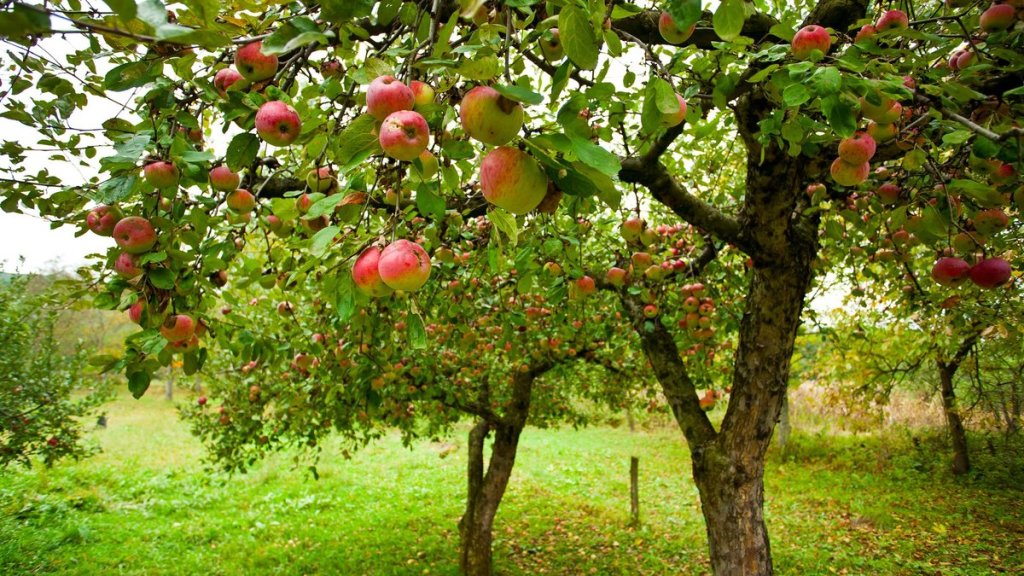
I have fond memories growing up of visiting many apple orchards in the mountains of North Georgia. There’s something about apples, mountains, and fall weather that just go together. I vividly remember walking through the tall grass in between rows and rows of apple trees, with the occasional farm animal announcing itself in the distance. The weather was cool, the shade even cooler. I remember one specific time when we were at a larger farm that grew all types of produce. As we walked along the rows of fruit trees we needn’t guess which tree was which. Why? We knew them by their fruit. The apple tree produced apples. The pear tree produced pears. The peach trees produced peaches. We knew which tree was which simply by the fruit it grew.
Occasionally, we’d encounter a tree that was sick, not producing any fruit, and on the verge of death. These trees would usually be inspected by the farmer and determined to be bad and of no use to the farm, uprooted and thrown in a fire. The farm simply has no use for a diseased or dead tree.
Let’s take a look at Matthew 12:33 – “Either make the tree good and its fruit good, or make the tree bad and its fruit bad, for the tree is known by its fruit” (ESV). The context here is that Jesus has just finished rebuking the Pharisees for their blasphemy of the Holy Spirit when they attributed a miracle of Christ to Satan (Matt. 12:22-32). He spends the next couple of verses illustrating how actions, specifically our words, are a reflection of a person’s heart. Just like a diseased tree, the Pharisees were producing bad fruit by the words they were saying. The Pulpit Commentary says this: “You wonder that I make so much of words; words are not trivialities, but are really the legitimate and normal fruit of the heart, and therefore by them each man will be judged” (H. D. M. Spence, Joseph S. Exell). It must be noted that this is the second time in Matthew’s gospel that Jesus refers to the heart as a tree. In the Sermon on the Mount, Jesus compares the heart to a tree, “By their deeds you shall know them; for as is the tree so is its fruit.” I like how Gill’s Exposition of the Bible explains this passage, “For the tree is known by his fruit; fruit will discover what a tree is, and accordingly judgment may be made. No man will say a tree is good, and its fruit corrupt; or say, that a tree is corrupt, and its fruit good: these are glaring contradictions, and can never be reconciled. The case Christ here puts, is a very easy and familiar one, and is obvious to common sense: the application of it may be made, either to the foregoing instance of Christ’s casting out devils, which the Jews ascribed to the help of Satan; and then the sense is, either say I am a good man, and do good works, or that I am an evil man, and do evil works: to say that I do good works is as great an inconsistency, as to say that a corrupt tree brings forth good fruit.”
I’ve always been fascinated by the clarity in which Jesus preaches in the four gospels. He uses illustrations that are familiar and compelling to understand. One such example is Matthew 12:33. Examine your heart. Check to see if your heart is positioned towards Christ. When we are in Christ and living for His glory and honor, we naturally bear fruit. Just like if a farmer plants an apple tree deep within the ground, waters it regularly and ensures it gets plenty of sun, the tree will have no option but to grow. All of the conditions are right. If your heart is not positioned towards Christ, your leaves will begin to wither and the fruit will fall away. Perhaps you’ve seen this in others. Stay connected to the only source that can provide what our hearts need: Jesus Christ.

 Jacob Robertson
Leave a comment